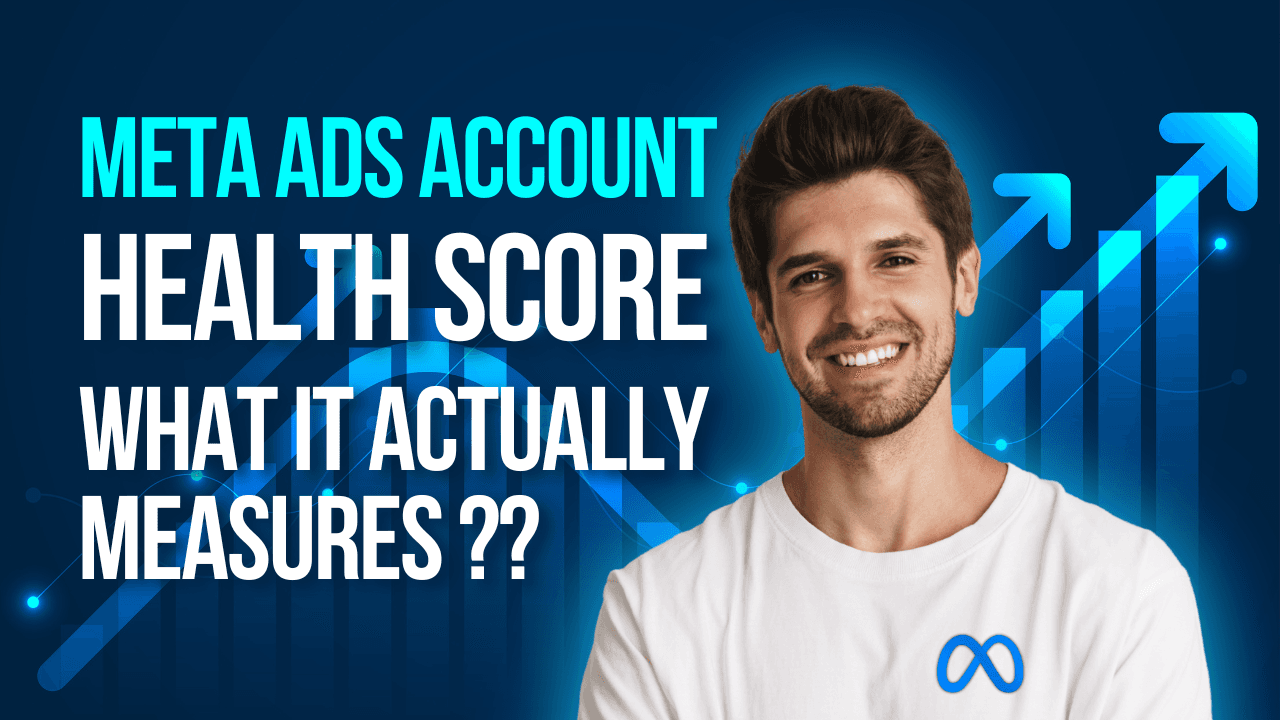
A single number that tells you whether your Meta Ads account is healthy sounds appealing precisely because Ads Manager doesn't give you one, it gives you dozens of individual metrics and leaves the synthesis to you. Several tools in this space now offer some version of an account health score, which raises a fair question before trusting any of them: what's actually behind the number, and how much should you trust it?
What a Meaningful Health Score Should Be Built From
Not every "score" is computed the same way, and the difference matters. A score worth trusting should be:
Built from your account's own data, not a generic industry benchmark. A score that just compares your ROAS to an average across all ecommerce businesses is telling you very little, your breakeven ROAS depends entirely on your own margins, which a generic benchmark can't know.
Composed of specific, checkable components, not a black-box output. If a tool gives you a score of 72 with no explanation of what's pulling it down, that number isn't actionable, you know something's off, but not what, which leaves you back where you started, just with an extra number to worry about.
Based on patterns that have a real mechanism behind them, not a loose correlation. A score that flags "frequency climbing, CTR sliding, CPM flat" as creative fatigue is pointing at a specific, understood mechanism. A score that just says "your account looks worse than last month" is a restatement of data you already had, not new insight.
Continuously updated, not a one-time snapshot. Account health changes day to day. A score generated once, during onboarding, and never refreshed isn't tracking health, it's a historical artifact.
How WizeScale's Score Is Built
WizeScale's Score is computed by a deterministic rules engine, meaning it's built from explicit, defined rules checked against your account's real, current data, not a model guessing at what "healthy" looks like. The engine evaluates specific patterns: creative fatigue signatures, audience overlap, tracking discrepancies between platform-reported and store-reported revenue, delivery instability from learning-phase resets, and budget efficiency, among others.
Each contributing factor is a named signal, not a hidden input, if your Score is lower than you'd like, you can see specifically which signals are contributing and why, rather than being handed a number with no explanation. That's a deliberate design choice, not a default: a score you can't interrogate isn't much more useful than no score at all.
Why the Connection Method Is Part of What You're Evaluating
This is a part of choosing an account-health tool that's easy to skip past, but shouldn't be: how the tool connects to your ad account matters as much as how it computes its score.
Some tools in this category request write access, the ability to actually pause campaigns, change budgets, or adjust bids on your behalf, typically framed as "automation" or "optimization." That's a legitimate product choice for a tool built to take action for you, but it's a materially different risk profile than a tool that only reads your account's data.
WizeScale connects read-only. It computes the Score, surfaces signals, and generates recommendations, but it never pauses a campaign, never changes a budget, and never touches a bid, every action it recommends, you execute yourself, in Ads Manager, on your own judgment. This isn't a limitation being explained away; it's a deliberate scope decision, and it means the question "what happens if this tool makes a mistake" has a fundamentally smaller blast radius than it does for a tool with write access to your account.
If you're evaluating any account health tool, it's worth asking directly what level of access it requests, the answer tells you as much about the tool's actual risk to your account as its score's accuracy does.
What a Good Score Actually Enables
The point of a health score isn't the number itself, it's what the number lets you stop doing manually. Instead of reviewing forty metrics across every campaign every week trying to spot what's changed, a well-built score does that synthesis for you and tells you specifically where to look, ranked by how urgent each issue actually is.
That's a meaningfully different workflow than checking Ads Manager and hoping you notice what matters. It's the difference between actively hunting for problems and having problems surface to you, named and specific, when they cross a threshold that actually matters.
What to Watch Out For
A health score is only as good as what's behind it, and a few warning signs are worth knowing before trusting one:
- A score with no visible breakdown. If you can't see what's contributing to the number, you can't act on it, and you can't verify it's measuring anything real.
- A score that never changes even when your account clearly does. If performance shifts meaningfully but the score stays flat, either the score isn't sensitive to what actually matters, or it's being computed too infrequently to be useful.
- A tool that requests write access without explaining why. If a tool needs to change your account to compute a health score, that's worth questioning, reading data and acting on an account are different capabilities, and only one of them is actually required to diagnose a problem.
What the Number Should Earn You
An account health score is a genuinely useful synthesis of information Ads Manager doesn't give you directly, but only if it's built from your own account's real patterns, broken down into components you can act on, and connected in a way that matches the actual risk you're comfortable taking on. Ask what's behind the number and how the tool accesses your account before trusting either.
See what's behind your own account's Score. Connect your Meta Ads account to WizeScale, read-only, always, with every contributing signal visible.